Though not actually a comic, or intended to be funny, this is a picture of a new billboard advertising the Creation Museum here in the "Bible belt" of the United States.
While this should be hilarious, I find it sad that there is a place masquerading as a "science museum" that is teaching people that fire breathing dragons were real, and co-existed with humans sometime in the past 5,000-6,000 years, all because dragons happen to be mentioned quite frequently in the bible. I'm all for the right to teach people your fundamentalist religious beliefs if you so desire, but don't claim that it has anything to do with science. In fact, I'm even willing to help the cause by pointing out that the most prominent references to dragons in the bible are in the book of revelations, which relates events that, even by biblical literalist standards, have not ever actually happened. AND, in that book, the dragon is described as being red and having seven heads and ten horns... so, perhaps the joke here is that the creation museum can't even get the bible right... and yet, so many visitors will go there and think that they have actually learned something about paleontology and the history of our world.
Sunday, June 17, 2012
Sunday, June 3, 2012
Saturday, June 2, 2012
Dire Wolves are real! (Dragons, not so much)
Yes, dire wolves are real, or, at least, they were...
If you are a fan of the "Song of Ice and Fire" series of books by George R. R. Martin, or the more recent "Game of Thrones" tv series adapted from them, then you likely know about dire wolves: the overly large wolves that are portrayed as almost magical beasts and tremendous hunters. Well, as it turns out, dire wolves did exist... and they could grow to about double the size of modern wolves. Though it is believed they were better scavengers than hunters, eating the leftovers (perhaps) of saber-toothed tiger kills.
If you are a fan of the "Song of Ice and Fire" series of books by George R. R. Martin, or the more recent "Game of Thrones" tv series adapted from them, then you likely know about dire wolves: the overly large wolves that are portrayed as almost magical beasts and tremendous hunters. Well, as it turns out, dire wolves did exist... and they could grow to about double the size of modern wolves. Though it is believed they were better scavengers than hunters, eating the leftovers (perhaps) of saber-toothed tiger kills.Tuesday, May 29, 2012
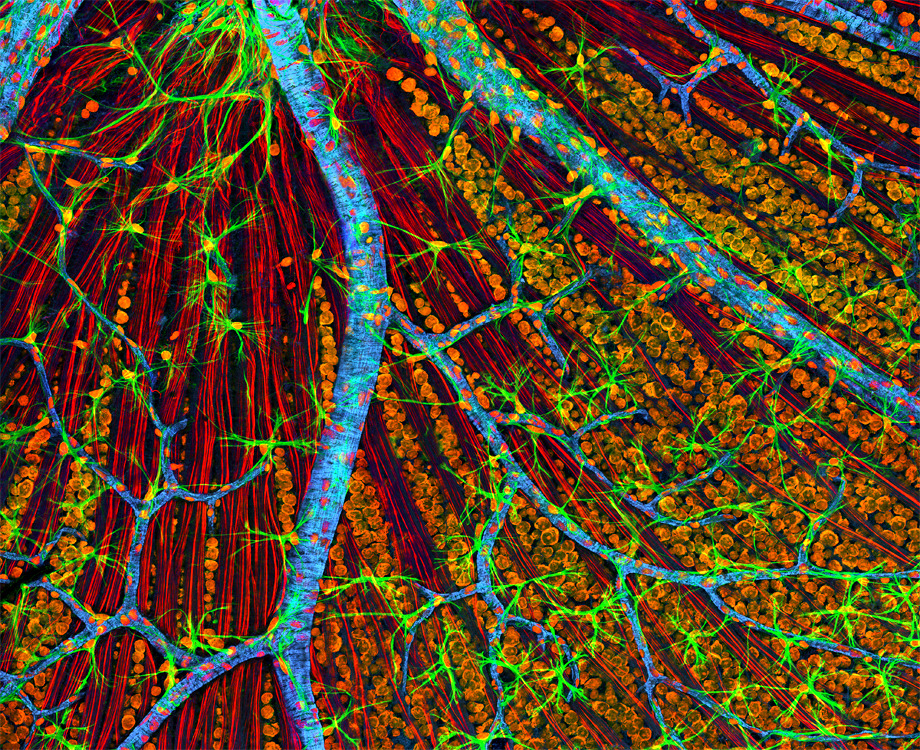
Science as Art
One of the things I love about being a neurobiologist is just how stunningly beautiful so many neural systems can be. Truthfully, there are many of these types of images that can be found throughout biology and really in all branches of science, however, this one comes from a blog I recently discovered that appears to be dedicated to all things neurosciencey. My thanks goes out to the Neuroimages blog, where you can see lots more like this one...
... it's a mouse retina in case you were curious.
Tuesday, May 8, 2012
The worst supplement ever, and no, this is not a made up news story
I don't think (or at least I hope) you don't need a scientist to tell you: "DON'T EAT THE PILLS MADE FROM DEAD BABIES!" Similarly common sense should tell you that these "supplements" (made by microwaving dead human stillborn infants and then grinding them into powder) will almost certainly NOT increase your sexual stamina or cure whatever ails you (which I am not basing on any scientific studies, just the fact that every supplement that has ever claimed to cure everything has turned out to cure nothing). BUT, in case you do need some science to help you determine whether or not you should go ahead and try these things anyway, the BBC reports that harmful, antibiotic-resistant bacteria have been detected in confiscated samples. Something to think about the next time you order some poorly labeled "herbal" stamina-boosting pills from the internet or tell someone that their baby is "cute enough to eat".
Monday, April 30, 2012
Are anti-smoking ads really effective?
If you've seen these commercials anywhere, you have probably had a strong reaction to them (good or bad). Personally, I think they are great, and I would have guessed (gut feeling only, not scientifically based) that they would not only be effective, but more effective than milder commercials. Of course, it would seem that people are terrible at guessing which anti-smoking ads are most effective, so perhaps I am wrong...
Your brain knows which ads are winners, better than you do: Study on smokers' brains may mark dawn of new age in advertising
Although, another recent study suggests that just about any anti-smoking messages that get out there are effective to some degree...
http://www.sciencedaily.com/releases/2012/04/120419132503.htm
So, I look forward to seeing this and hopefully many other anti-smoking ads during my (far too regular) tv viewing.
Sunday, June 5, 2011
Best Illusions of the Year
A little while back I posted that I was reading a very interesting book called Sleights of Mind by Stephen L. Macnik and Susana Martinez-Conde. In the book, the authors describe an online contest to determine the best new illusions every year. The contest is in its 7th year, and recently, the winners were announced. Personally, I liked the "Grouping By Contrast" and the "Mask of Love" illusions the best, but then, to each his own I guess.
The Mask of Love: Do you notice anything unusual about the mask in the center? Look closer and you may see a photograph of two faces rather than one, a man and a woman kissing.
Subscribe to:
Posts (Atom)