Friday, October 31, 2014
Halloween Post: Paging Dr. Frankenstein to Cardiothoracic Surgery... Dr. Frankenstein to Cardiothoracic Surgery.
― Mary Shelley, Frankenstein
When Mary Shelley published the novel Frankenstein; or The Modern Prometheus in 1818, it received mixed critical reviews at best, but became wildly successful with the public and remains one of the most widely recognized and influential horror figures to this day (along with Dracula, the Werewolf, and the Mummy). The book, which is one of my all time favorites, is analogous to the Greek myth of Prometheus who stole the knowledge of how to make fire from the gods to give to humans. Similarly, Dr. Frankenstein, supposedly using medical science, steals from God (or nature, depending on your interpretation) the ability to create life in the form of Frankenstein's monster. While the book is an excellent exercise in examining the dualistic nature of things like fire (good: brings light and warmth, bad: can burn or destroy) and knowledge (good: can bring light and warmth, bad: can burn and destroy), it is almost certainly remembered for the "monster" who was created from the body parts and organs of the dead and reanimated with the help of the electricity provided by a particularly violent lightning storm. When Shelley's book was first published, this was an incredibly radical idea (and still is), and many of her critics panned the book because the premise was so far-fetched, and "horrible, disgusting, and absurd".
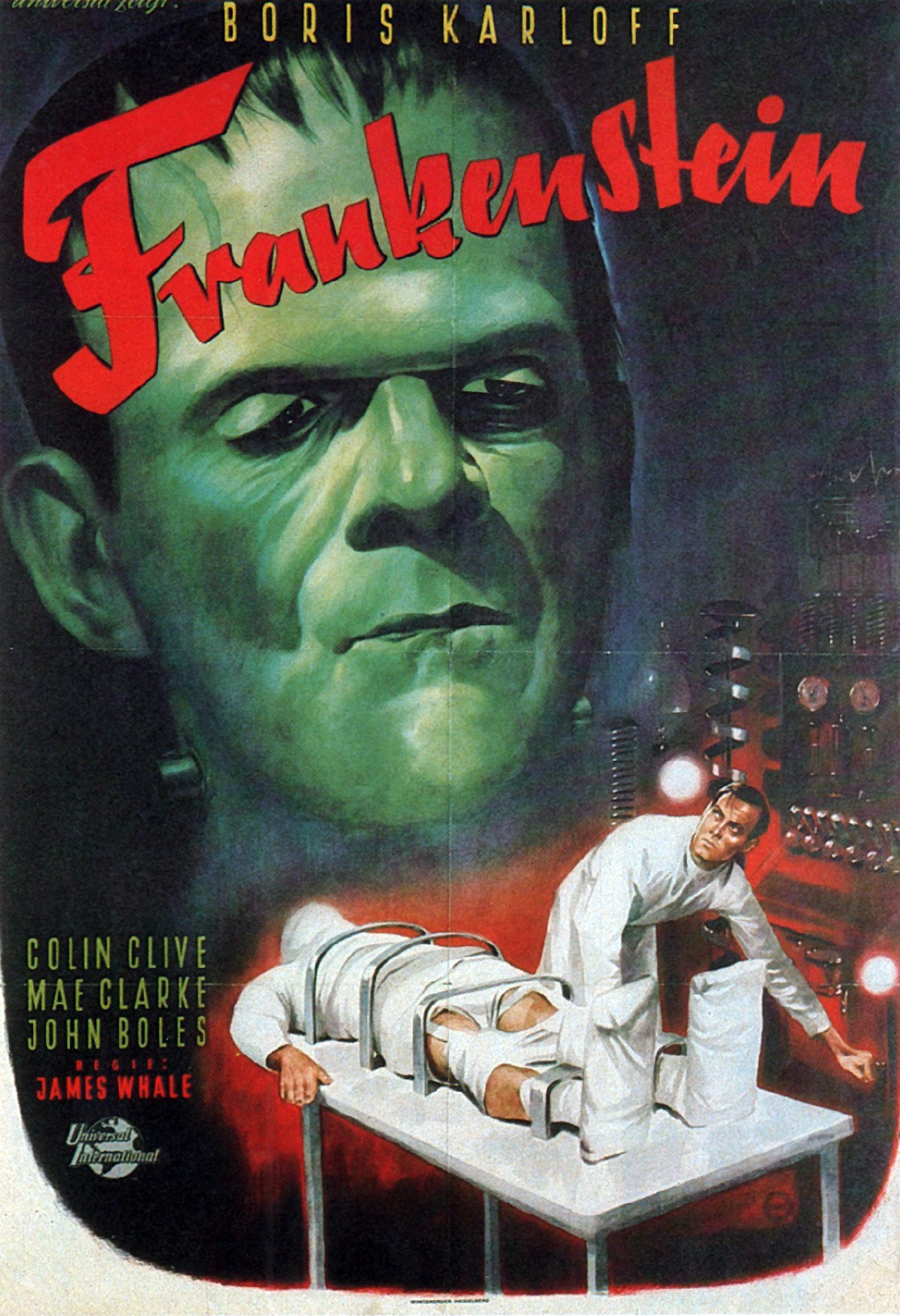
Well, perhaps the book is still horrible and disgusting (something that I think adds to rather than detracts from its popularity), but absurd, it may not be. In the late 1700's and throughout the 1800's many scientists (e.g. Ben Franklin) were playing around with lightning. Toward the end of the 1800's and 1900's physiologists discovered that small electric shocks could stop a heart from beating, but more importantly that larger shocks could restart it. This led to the electric defibrillators that we still use today. BUT, as exciting as that is, restarting a heart that is alive is not the same as re-animating tissue from a dead body. The first real success in that regard came with the first organ transplants in the 1950's, where organs like kidneys and hearts were taken from recently deceased patients and transplanted into live patients where they could resume their normal functions and save lives. However, until now, the organs had to come from someone nearby and who had just died because the tissue would start dying. Keeping the organ in question on ice helped to increase time since death and distances that organs could be transported before being transplanted. BUT, according to a press release just last week, researchers at St. Vincent's Hospital in Australia reported that they had successfully transplanted hearts into patients that had come from patients who had been dead longer and who had lived farther away from the recipient patients than ever before. How did they accomplish this impressive feat? With the help of the ex vivo organ care system (OCS) also known as the "heart in a box". By connecting the donor heart to an artificial circuit that keeps it warm and beating and perfused with a nutrient filled fluid Doctors at St. Vincent's found that they could now use hearts from donors very far away and possibly even from donors who may have been dead, or at least brain dead, for longer periods of time. If these initial results are replicated, this could mean good news for people who are on the very long wait lists for donor hearts, and maybe for people waiting for other organs as well as systems similar to the heart OCS are developed for other organs.
Although, if your cardiologist's name happens to be Frankenstein, you still may want to get a second opinion. Happy Halloween!
Friday, February 14, 2014
Happy Valentine's Day: Some interesting things about love and longing
According to a study in the Journal of Communication, couples in long distance relationships are better at communicating and as a result report a greater feeling of intimacy than couples who get to see each other face to face. But what about the age old adage: "Long distance relationships don't work"? Well, in our modern world, that may not be true, according to another survey, unmarried couples in long distance relationships reported similar quality of relationships to those living in close proximity, with couples in long distance relationships reporting greater satisfaction in... you guessed it, communication and intimacy! Long distance couples were also better at discussing sex, though, due to obvious restrictions, tend to have less actual sex than couples living in close proximity.
Thursday, February 13, 2014
Happy Darwin Day!
Wednesday, February 12, 2014
Holy Crap! We have achieved fusion!
Tuesday, February 11, 2014
Olympics Re-post: Why some athletes are caught yawning right before they compete
I find this little story interesting for a couple of reasons. First, yawning in anticipation of a competitive event is not that unusual. According to Robert Provine, professor of psychology at the University of Maryland Baltimore County, "at track and field events, sometimes you'll find participants in the race of their life will be standing around on the sidelines or in the starting block and they may be yawning. Or before a concert, a musician may yawn to prepare for an increasingly energized state". And this trait is not only obvious in humans. Ronald Baenninger from Temple University reports that "lions, mandrills, and fighting fish all yawn in anticipation of metabolically expensive events such as feeding or fighting." So, Ohno's pre-skating tradition may not be so unusual.
But since the subject has been broached, I'm curious... In seeing the accompanying picture or in reading this post on yawning, have you felt the urge to yawn? Maybe let one or two slip by? Sadly, I've already yawned several times just in writing this. So, what causes Apollo Ohno, or more generally, the rest of us to yawn? And why are yawns contagious?
The truth is no one really knows. Several hypotheses have been put forward over the years, with the most popular going something like this: yawning is caused by either excessive carbon dioxide or a lack of oxygen either in the lungs or in the circulation. This idea is so prevalent, it can still be found in some medical texts. However, in a study conducted in the 1980s by the same Robert Provine quoted above, subjects were exposed to environments that were either high in carbon dioxide or high in oxygen with neither having an effect on yawning. So, neither low oxygen, nor high carbon dioxide are to blame for our yawns. But how about heat? Or, rather, overheating? The latest hypothesis to be put forward is that yawning may act to cool our overheated brains, kind of like the radiator in your car. The more the engine works, the hotter it gets, the radiator takes the ambient air, which is cooler and uses it to bring down the temperature of the engine. In a similar way, our brains actually increase in temperature as a result of use and fatigue, and yawning takes in cooler, ambient air, and increases blood flow in the face and head, thus carrying cooler blood past the brain. The evidence for this hypothesis comes mainly from a single study that showed that contagious yawning could be decreased by holding a cold pack up against one's head (or by making a conscious effort to breathe through the nose, which also cools the brain). Of course, more study will be needed to say whether or not yawning is meant to cool our brains, but it is interesting that certain diseases, like multiple sclerosis, which have a component of thermodisregulation (inability to regulate temperature) are also characterized by excessive yawning.
Regardless of whether or not cooling the brain is the end goal, it appears that the overall purpose of yawning is to help us stay awake and alert, which is why being tired or bored are the most common triggers, and why athletes will yawn before a big event as they try to get focused.
But what of the contagiousness of yawns? Aside from the fact that a person with a cool brain seems to be less susceptible to catching your yawn, what else do we know?
Much like the function of yawning, several attempts have been made to try and explain the contagiousness of yawning. When the oxygen and carbon dioxide hypothesis was still considered valid, it was proposed that the yawns of people around you expelled excess carbon dioxide into the air you breathe, causing you to take in excessive carbon dioxide, and thus you yawn.
Obviously, there are a couple problems with this... first, yawning is not caused by changes in carbon dioxide (or oxygen) as we saw above. Second, even if carbon dioxide levels were to blame, it has been shown that just watching video of people yawning, or hearing someone yawn, or reading about yawning can all cause people to yawn more (and since the stimulus yawn isn't even happening in the same room or at the same time, there is no change in CO2 or oxygen levels).
Okay, so what else? Well, another hypothesis that came into vogue after it was discovered that carbon dioxide was not to blame was that yawning somehow activated the mirror neuron system. The mirror neuron system is made up of neurons that fire not only when we perform a certain action, but when we see the same action being performed by someone else. Many neuroscientists speculate that these mirror neurons are important for our ability to imitate others (which is how we learn to do many things like talk, write, play sports, learn a trade or craft, etc.) However, studies published in 2005, and in 2009 that used fMRI imaging to examine the brains of people who were "catching" a yawn suggests that the parts of the brain where the mirror neurons reside don't seem to be activated in this process.
So, the latest hypothesis gets back to the now more accepted idea that yawns are meant to stave off exhaustion and increase alertness. Examples of contagious yawning in other social animals (like baboons) suggests that there may be an evolutionary benefit to catching a yawn. While some suggest that the contagiousness of yawns in social animals reflects empathy and a means to strengthen social bonds by synchronizing behaviors (like when to go to sleep), others have suggested that the raised awareness brought on by a yawn provides enough of an evolutionary incentive for it to "catch" on. For example, many species of birds feed in large groups because feeding is a dangerous activity for them, one that usually involves lowering their head and eyes to the ground to pick up food. A single bird by itself could get caught unaware by a predator whenever its head is down, but in a large group of birds, it is much more likely that when one bird has its head down, several others have their heads up, and are looking around. Thus, each bird can feel safe pecking at the ground, confident that one of his neighbors will sound the alarm if a predator approaches. When you have animals that live together in groups, and are likely on synchronized sleep/wake cycles (like baboons and early humans), then yawning may act as another sort of alarm. When one in the group yawns, he or she is signifying fatigue, or a need to stay alert. Others that follow this lead will likely reap the same arousing effect and be more likely to have the alertness and focus needed to successfully elude an approaching predator, or to have a successful hunt. Thus contagious yawning may have evolved in our primate ancestors as a means for increasing alertness when it was needed, and yawning athletes appear to be a manifestation of this held-over trait, giving them added alertness before they enter the "hunt" for gold.
Friday, February 7, 2014
More unintelligent designs on teaching creationism
Tuesday, December 31, 2013
Probably my favorite science news story of 2013...
Tuesday, December 24, 2013
If the stress doesn't kill you, believing that it can kill you just might
This is a great example of the nocebo effect, which is the evil cousin of the placebo effect. As we all know, a placebo effect is when you experience a presumed benefit from an inert material simply because you don't know it is inert, but instead think it to be an active compound... the old "sugar pill" in the drug trial. But what happens if you believe the sugar pill is actually something that is bad for you? As it turns out, things that have no effect could harm you if you believe they are harmful, or things that are only a little harmful could be made worse by your perception, as is the case here. So don't stress about the stress... you're only going to make it worse.
Sunday, December 22, 2013
Geek Gift Guide: Super Magnetic Thinking Putty
Monday, December 16, 2013
The geek gift guide, second day of Christmas: Experiments on babies
Saturday, December 14, 2013
Christmas Geek Gift Guide: Non-Newtonian Sand
Friday, December 13, 2013
An artificial sweetener in research news NOT for causing cancer,
Tuesday, June 18, 2013
Impact schmimpact. Now give me some money.
Apparently NIH is now asking grant applicants to include a segment about the impact their proposed project will have. The problems with this are myriad. First, this means that for this section of the grant the most points will be awarded to... the best bull-shitter. That's right: "your project will lead to a cure for cancer while also preventing Alzheimer's AND save the polar bears?!? Well here you go! Are you sure we can't give you more money?" Please! Like anyone could have predicted that studying fluorescent and luminescent proteins in jellyfish and fireflies would have led to pretty much ALL the major medical breakthroughs and drug discoveries of the last few decades. I'm pretty sure their discoverers weren't thinking about it at the time. They were probably just thinking " hey, that animal glows in the dark! That's pretty cool! How does that work?" Bam! Nobel prizes and major biomedical breakthroughs all around! Congrats everybody. But don't take my overly sarcastic word for it. Check out this editorial in the latest issue of science for a much more eloquent breakdown of this unfortunate trend in science policy:
http://m.sciencemag.org/content/340/6138/1265.full
Saturday, May 25, 2013
Backlog Data Dump...
"Barking up the wrong tree" has a fun list of a bunch of cliches and sayings with links to research on whether or not they could be true, so click here if you want to know whether or not nice guys finish last, if you can tell a lot about a man from his handshake, and if blondes have more fun.
Over at EurekAlert is a blurb about a Banaca-like oral spray that could help cut down on your susceptibility to airborne flu virus... the secret ingredient (cetylpyridinium chloride) is also a main ingredient in some non-burning mouthwashes, so using the right mouthwash frequently might also help to cut down on your flu susceptibility (though that has yet to be tested).
Apparently the guys over at Freakonomics are also fans of the band Bullets for My Valentine becaue they posted this podcast about guns in America just this past Valentine's Day. Despite the interesting timing of the piece, no word yet as to whether Cupid has traded in his bow and arrow for a Mac-10.
And over at The Scientist is a story about how the males of a certain species of sea slug can actually detach their penises after mating (likely to prevent other potential suitors from getting in there and competing with their sperm), and then amazingly they can grow a new penis the next day. I believe some of the credit for the discovery should go to early 90's rockers King Missile who first postulated the possibility of such a phenomenon in their song "Detachable Penis"
Sunday, March 24, 2013
Could just thinking about science make you act morally?
"Another important caveat is that it’s a typical psychology study, using a small pool of undergraduates at the University of California Santa Barbara, so they’re actually tapping into very narrow cultural norms. A group of students who were familiar with the Tuskegee syphilis study, to name just one exception, might respond to priming with science words very differently, while people from a less science-dependent culture might find the exercise meaningless."
He goes on to conclude that the important thing is that if some thing becomes widely accepted in a culture as being related to positive moral action, then just reflecting on that thing (be it religion, or science, or Bill or Melinda Gates) will make us more likely to adhere to the moral norms associated with it.